The nap that stopped happening
It is quarter past four, and the last nap of the day was supposed to start twenty minutes ago. Instead there is a baby lying in a dark room, wide awake, kicking the mattress and finding the whole thing extremely funny. Forty minutes later we give up. Bedtime slides to a quarter past eight. The next morning starts at twenty to six.
Once, that is a bad day. Four days out of seven, two weeks running, and it is something else: the day now has one nap too many in it.
Nap transitions are one of the quietest sources of hard weeks in the first two years, mostly because nothing announces them. The schedule that worked in March simply stops working in April, and the instinctive response is to try harder to make the nap happen, which tends not to work.
A transition is not a decision anyone makes — it is arithmetic catching up with a baby who can now stay awake longer.
Six, five, four, three, two, one
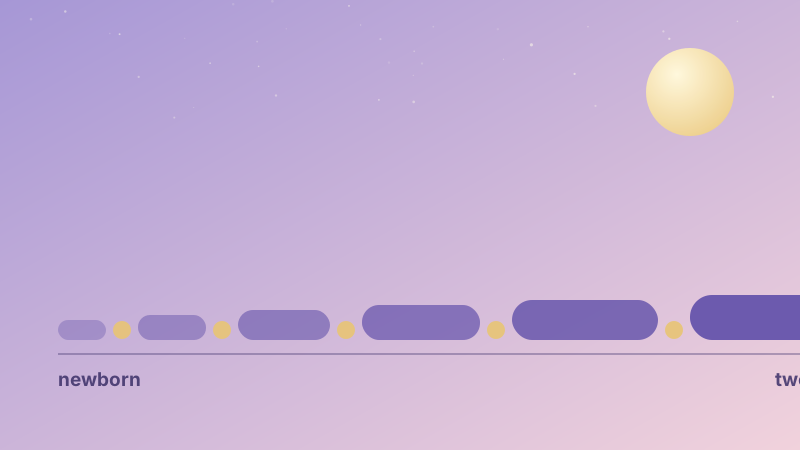
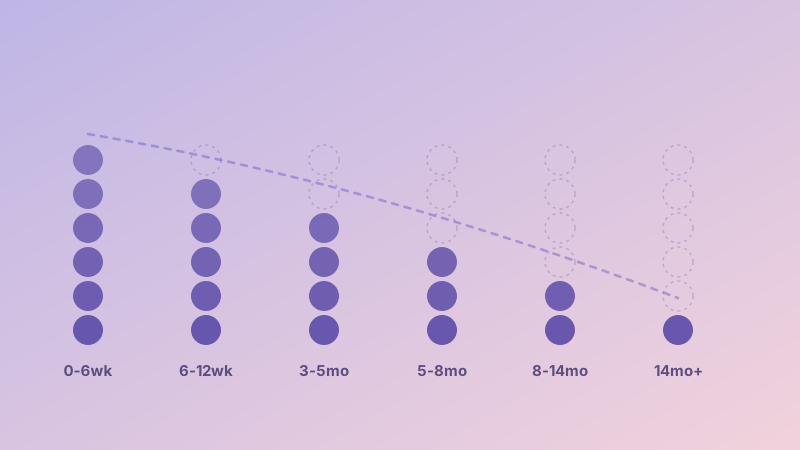
Babies do not drop naps on a timetable, but the order is consistent and the rough ages are known. Here is the whole ladder, with the awake time between sleeps that tends to go with each step.
- Under 6 weeks, four to six naps. Awake stretches run about 45 to 80 minutes. The first consolidation, down to roughly four naps, usually arrives around 8 weeks.
- 6 to 16 weeks, three to five naps. Windows widen to 60 to 100 minutes, then to 90 to 120 minutes from about 12 weeks. Most babies consolidate to about four naps around 3 months.
- 16 to 28 weeks, three to four naps, settling toward a steady three. From roughly 22 weeks the awake stretches run 115 to 160 minutes.
- 28 to 60 weeks, two to three naps, with a long midday nap anchoring the day. The three-to-two drop usually lands around 8 to 9 months, and windows step up to 175 to 225 minutes.
- 60 weeks to 3 years, one midday nap. Most toddlers move to a single nap between 13 and 18 months, awake for roughly four and a half to six hours at a stretch.
- Naps usually disappear entirely between 3 and 5 years.
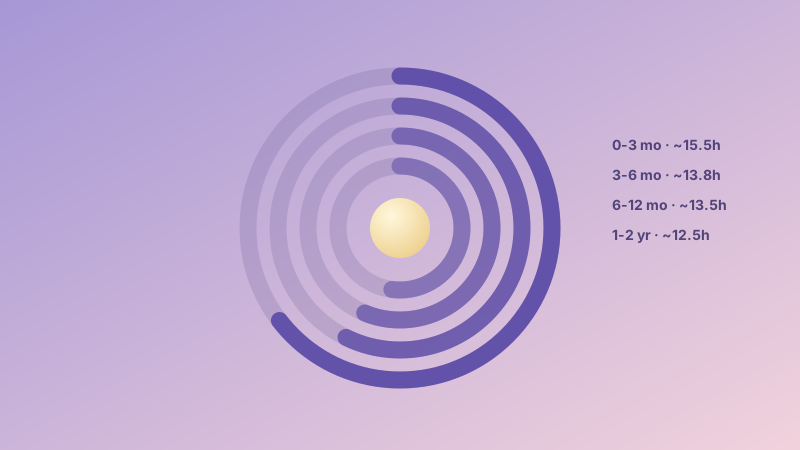
Total sleep in 24 hours, naps and night together, drifts down alongside it: 14 to 17 hours in the first three months, 12.5 to 15 hours to about six months, 12 to 15 hours through the rest of the first year, 11 to 14 hours in the second. Those bands are wide on purpose. Healthy babies land all across them, and some land outside.
Notice what moves together. The awake window widens at almost exactly the point the nap count falls, because that is the mechanism: a longer awake stretch is what removes a nap from the day. A transition is not a decision anyone makes. It is arithmetic catching up with a baby who can now stay awake longer.
A transition, or just a bad week
Three signals tend to arrive together, and the combination matters more than any one alone.
- The last nap refuses to happen. It is almost always the last nap of the day that goes first, not the first one. The baby who used to fall asleep in five minutes now lies there cheerfully for forty.
- Bedtime drifts later on its own. Not because anyone pushed it. The last nap ended at the usual time, and settling now takes an hour, or the baby is plainly not tired at the hour that used to work.
- Mornings start early. Five, or half past, cheerful rather than distressed, and not hungry. Early waking is often mentioned alongside the other two, which surprises people. On its own it means very little — plenty of things wake a baby early.
Two weaker signs: naps shortening week by week until a 90-minute midday sleep is reliably 35 minutes, and night wakings reappearing.
Now the caveats, because most weeks that look like a transition are not one. A tooth, a cold, a sore ear. Travel, a new room, a new cot, the season shifting the light. A big motor skill arriving, since rolling and pulling to stand get practised at two in the morning. A change in who runs the day: nursery, a grandparent week, a return to work.
Most days of the week, for two weeks, with no illness, travel or new tooth that would explain it, is the pattern people usually call a transition rather than a bad week. It is a rule of thumb, not a diagnosis — ruling out illness is a doctor's job, not a checklist's.
Two weeks feels long when we are the ones awake at five. It is still worth waiting, because a guess in either direction is hard to walk back.
One number all day is an easy mistake
This part is rarely explained, and it matters most in the weeks around a drop. Wake windows are not all the same length within a day. The first stretch after morning wake-up is the shortest of the day. The one before bedtime is the longest.
Cradle builds that shape into the ladder it shows you: roughly plus or minus 35 per cent around the age midpoint on a four-window day, 25 per cent at three, 15 per cent at two. That is how the app spaces a day, not a measurement of babies. The average stays at the midpoint, so total awake time is unchanged. Only its distribution moves. Repeating one flat number from breakfast to bedtime is an easy way for a schedule that was working to stop working.
These are the ladders Cradle would draw at those ages, rounded. They are a starting shape to adjust from, not times to hit.
- Seven months, three naps (midpoint about 2 hours 18 minutes): roughly 1h30, then 2h, then 2h35, then 3h05 before bed.
- Ten months, two naps (midpoint 3 hours 20 minutes): roughly 2h30, then 3h20, then 4h10 before bed.
- Fifteen months, one nap (midpoint 5 hours 15 minutes): roughly 4h30, then 6h before bed.
Two things follow. The day flattens as naps disappear, so a four-nap day is steeply ramped and a one-nap day is nearly level. And the last window has to grow substantially every time a nap comes out: from three naps to two, the pre-bed stretch moves from around three hours to over four. Hold it at the morning length and one of two things happens. Bedtime arrives with a baby who is not tired, or we reach for a late catnap at five that takes the edge off the night.
What too early and too late tend to look like
Parents commonly describe the week after an early drop as an overtired one — shorter naps, more broken nights, an early start. Babies vary enormously, and this is not a rule about any particular baby. The trap is that this looks exactly like the problem we thought we were solving, so the temptation is to push further in the same direction.
Holding on too long is subtler. The extra nap starts borrowing from the night. A late nap pushes bedtime past a sensible hour, or the nap is fought for forty minutes, yields twenty, and those twenty minutes are enough to turn bedtime into a negotiation.
From the outside these look alike. What separates them is which end of the day is falling apart. Dropped too early, the mess is in the afternoon and the small hours. Held too long, the damage sits at bedtime and around the last nap.
How to run the fortnight in between
None of this is medical advice, and none of it is required. It is what parents tend to find helps them through the messy fortnight:
- Alternate. Three-nap days and two-nap days in the same week is not backsliding, it is the transition. A baby who slept badly last night will often still take the extra nap today.
- Use bedtime as the shock absorber. On a day the nap does not happen, many parents bring bedtime forward 30 to 45 minutes rather than stretching to the usual hour.
- A bridge nap is allowed. Twenty minutes in the pram or the car on a hard day is a tool, not a failure.
- Move the remaining nap slowly. Fifteen minutes later every few days beats one big jump, especially at two naps to one, where a half past nine morning nap has to migrate to the middle of the day.
- Expect two to six weeks. The messiness in between is not evidence the decision was wrong.
What the logs show, and what they cannot
The wake windows and nap counts above are built on published pediatric sleep research. The 24-hour totals are the widely published consensus ranges for each age. How Cradle spaces those windows across a single day is our own implementation of that protocol.
What a tracker can add is not proof of the protocol but a picture of the nights around it. Across the sleep families have logged in Cradle, two patterns hold. Two thirds of the sleeps were written down within a minute of starting, and about 1 in 7 of the sleep logs was made between midnight and 5am. That hour is not a rounding error in the log.
Every one of those figures describes what parents recorded, not what anyone measured. Cradle is not a monitor and does not observe a baby, so a missed log is simply invisible and these totals are floors rather than ground truth. They are population counts, not a portrait of a typical family.
One last thing. Every range on this page describes what is typical across a very large number of very different babies. None of it is a target, and none of it is a verdict. Babies vary enormously, and a baby sitting outside a band is not a baby with a problem. Anything genuinely worrying, whether breathing, weight, feeding, or a change that feels wrong rather than merely hard, belongs with their doctor, not an app or an article.