The arithmetic you did at 3am
You did the sum in the dark. Forty minutes in the car seat this morning, a long stretch from seven until eleven, an hour or so after the 2am feed, and whatever this is now. Call it eleven and a half hours. And somewhere on a chart you read last week, the range began at fourteen.
That gap is where a great deal of night-time worry lives. So here is the honest version of the answer: the ranges written out plainly, and the part that usually gets left off the chart. The ranges are enormously wide. They are wide on purpose, and healthy babies land all the way across them.
The width is not sloppiness in the chart; the width is the finding.
What the ranges actually say
These are totals across a full 24 hours, naps and night together, not night sleep on its own.
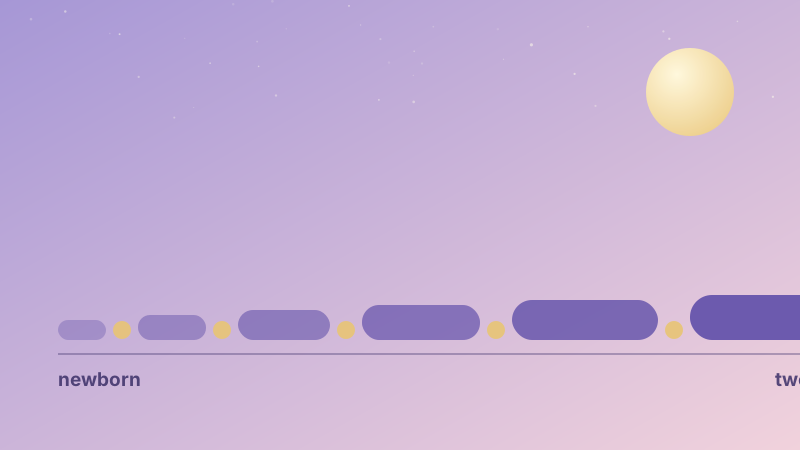
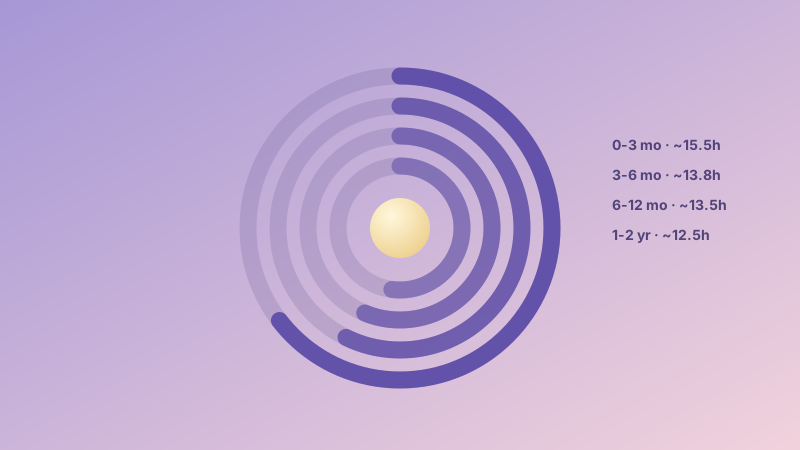
- 0 to 12 weeks: 14 to 17 hours
- 13 to 26 weeks: 12.5 to 15 hours
- 27 to 52 weeks: 12 to 15 hours
- 53 to 104 weeks: 11 to 14 hours
Read the width before you read the middle. At six months the band is two and a half hours wide. At a year it is three hours wide, and three hours is an enormous share of a small person's day. Two babies born the same week, both thriving, can sit at opposite ends of that band and both be entirely ordinary.
Wide on purpose
It is tempting to read a range as a tolerance band drawn around one correct number, as though 15.5 hours were the real answer and 14 were 15.5 with something missing. That is not what a range is. Sleep need varies between babies the way appetite and height do. The band describes a population. It is not a target with edges you can fail.
Which means it cannot tell us much about one baby on one day. Thirteen hours and forty minutes at ten weeks is not a worse day than fourteen hours and ten minutes. There is no line there to be on the wrong side of. The width is not sloppiness in the chart; the width is the finding.
If your baby lives at the bottom of the band
Some babies are simply low-sleep babies. The bottom edge is a real place where real, well, growing babies live, and the parent whose baby has been down there for weeks is often the most anxious reader of any sleep chart. Sitting low in a range is not, by itself, evidence of anything being wrong.
A 24-hour total is a thin slice of the picture. A doctor looking at the same baby would ask about more than the arithmetic — the trend across a week rather than one night, how feeding and growth are going, what the awake time looks like. Those are questions for a visit, not a checklist to work through alone at 3am.
The other direction matters too. A total sitting comfortably mid-band does not settle anything on its own, and no app can settle it either. Anything that worries us about a baby's breathing, weight, feeding or health is a conversation for their doctor, and it is worth having sooner rather than after another week of counting. A chart describes what is typical. It does not hand down a verdict on a particular baby, and it is not a score to hit.
Totals matter less than how the day is broken up
Fourteen hours at three months and fourteen hours at ten months are the same number and completely different days. What changes with age is the number of pieces, and the size of the gaps between them.
- Under 6 weeks: 4 to 6 naps, often consolidating to around 4 by 8 weeks.
- 6 to 16 weeks: 3 to 5 naps. Most babies settle to about 4 around 3 months.
- 16 to 28 weeks: 3 to 4 naps, working toward a steady 3.
- 28 to 60 weeks: 2 to 3 naps, with a long midday nap anchoring the day. The drop to 2 naps usually happens around 8 to 9 months.
- 60 weeks and beyond: one midday nap, which most toddlers arrive at between 13 and 18 months. Naps usually go entirely somewhere between 3 and 5 years.
A day that has just lost a nap often loses a little total sleep for a few weeks, while the remaining pieces stretch to absorb it. That dip is arithmetic, not a step backwards. It is also why the total is the least informative number on the page: it moves for reasons that have nothing to do with how the baby is doing.
Not every awake window is the same length
Here is a piece that gets less attention than the totals do, and shows up in the day to day. The gap a baby can comfortably stay awake for is not one number repeated from morning until bedtime. The first window after morning wake-up is typically the shortest of the day, and the one before bed typically the longest — though, as with everything here, babies vary.
The typical windows by age, in minutes awake between sleeps:
- Under 6 weeks: 45 to 80
- 6 to 12 weeks: 60 to 100
- 12 to 22 weeks: 90 to 120
- 22 to 36 weeks: 115 to 160
- 36 to 60 weeks: 175 to 225
- 60 to 104 weeks: 280 to 350
Those are the day's range, not its setting. Cradle spreads a day's windows around the midpoint of the band, and the spread softens as the day loses windows: roughly 35 per cent either side of the midpoint when there are four windows, 25 per cent at three, 15 per cent at two. The average stays on the midpoint, so the total awake time does not change. Only where it sits in the day moves.
In practice, Cradle lays out a seven-month-old's three-nap day as windows of roughly 90, 120, 155 and 185 minutes, and a ten-month-old's two-nap day as roughly 150, 200 and 250. Those are the plan's starting points, not times a baby is supposed to hit.
A flat number repeated from morning to night is an easy way to build a day, and it produces a different shape from a tapered one even when the totals match. Use one flat number instead — 200 minutes all day for that ten-month-old — and the same total awake time lands in a different shape: a longer first stretch after morning wake-up, and a bedtime earlier than the tapered version would put it. The total is identical; only the distribution moves. Which shape suits a particular baby is something only their own week can show.
Cradle's ladder is built on published pediatric sleep research, with the bands cross-checked against other published pediatric sleep tables.
What the logs can and cannot see
Feeds and sleeps are logged in almost equal number; nappies at about half that. Pumping and medication are a long tail. in all. About one in seven sleep logs in Cradle is made between midnight and 5am. Two thirds of sleeps are logged the moment they start.
Two honest caveats. These are records, not measurements — what a parent wrote down, not what a device observed. And a sleep nobody logged leaves no trace at all, so any total is a floor rather than the truth.
That is also the quiet reason a number from a friend or a forum is not a target. Her sixteen hours and your eleven and a half were produced by two different counting habits. Did the twenty minutes in the carrier count? Was the 2am resettle one sleep or two? Nobody's 24-hour total is precise enough to rank babies with, ours included.
So tonight's number is one data point about one day, and it is probably the least useful thing to stare at right now. Over a week, in this baby's own trend, a shape shows up. The counting can wait until morning.