The 4pm nap that will not go in
The first nap went in at 7:25 without an argument. The one you are trying for now, at half past four, is not going in at all. Same dark room, same white noise, same words. She is arching her back, and you are sitting on the floor beside the crib doing arithmetic.
Nothing has gone wrong, and neither of you has failed. The number you were handed once, about two hours awake at this age, is an average for the whole day, spent as though it were a rule. In the morning it is too long. By late afternoon it is far too short.
What follows is the full ladder, newborn to two years, and the part that usually goes unsaid: the windows inside one day are not the same length.
A range describes what is typical. It is not a target and it is not a verdict.
A window is measured sleep to sleep
A wake window is the time a baby is awake between one sleep ending and the next one starting. It is not a time of day and not a slot on a chart. It starts the moment their eyes open, not when you lift them out of the crib, and it ends when they are actually asleep, not when you start the wind-down.
Two things follow from that.
- Everything counts: the feed, the diaper change, the fifteen minutes of kicking on the mat, the trip to the store. All of it is inside the window.
- Settling is inside the window too. If your baby usually takes fifteen minutes to fall asleep, a 90-minute window means the room goes dark at 75 minutes.
Windows run sleep to sleep rather than by the clock because early naps are not steady enough to hang a clock on. A 25-minute nap and a 90-minute nap cannot share a schedule. A window schedule floats: a short nap moves everything after it and the day is still intact. A clock schedule breaks the first time a nap ends early. Around the single-midday-nap stage clock time starts working again, once the nap is long and stable.
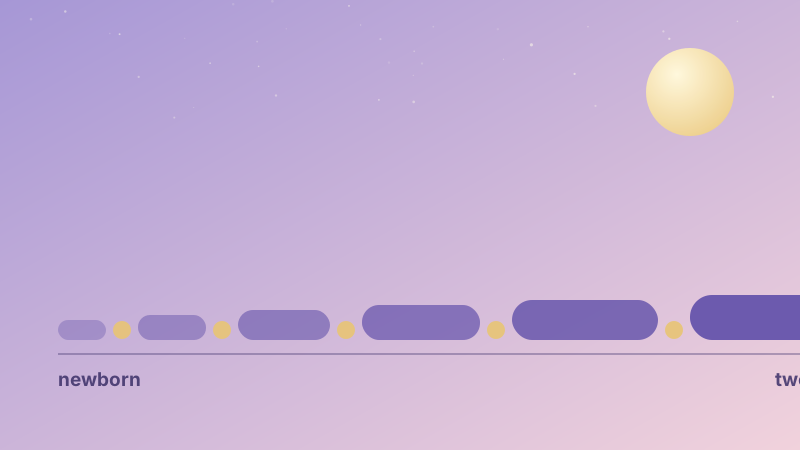
The ladder, newborn to two years
Awake time between sleeps, by age, with the nap count that goes with it.
- Under 6 weeks — 45 to 80 minutes awake, 4 to 6 naps. Most drop to about four naps around 8 weeks.
- 6 to 12 weeks — 60 to 100 minutes, 3 to 5 naps, usually consolidating to about four around three months.
- 12 to 22 weeks, roughly 3 to 5 months — 90 to 120 minutes, 3 to 5 naps early in the band and 3 to 4 by the end of it.
- 22 to 36 weeks, roughly 5 to 8 months — 115 to 160 minutes, 3 to 4 naps settling toward a steady three. The drop to two naps usually happens around 8 to 9 months.
- 36 to 60 weeks, roughly 8 to 14 months — 175 to 225 minutes, 2 to 3 naps, with one long midday nap anchoring the day.
- 60 to 104 weeks, roughly 14 months to 2 years — 280 to 350 minutes, one midday nap. Most toddlers move to a single nap between 13 and 18 months, and naps usually go entirely between three and five years.
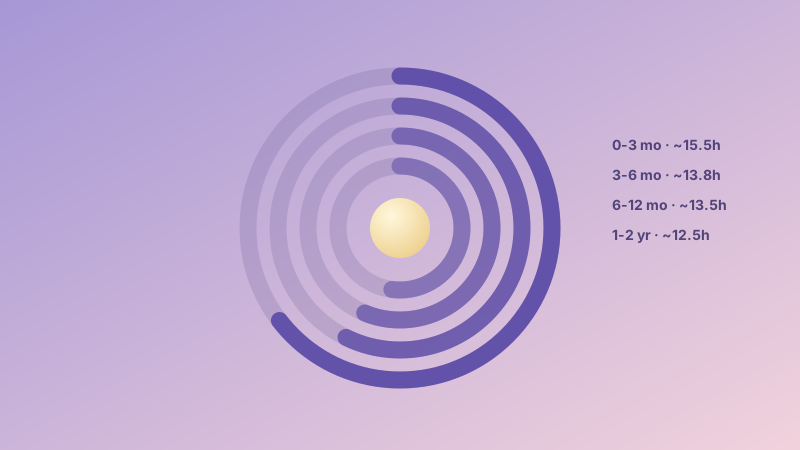
Published pediatric sleep references — the HealthyChildren.org consensus material and the standard pediatric sleep literature the app cites — put total sleep across a whole 24 hours, naps and night together, at roughly 14 to 17 hours at 0 to 12 weeks, 12.5 to 15 hours at 13 to 26 weeks, 12 to 15 hours at 27 to 52 weeks, and 11 to 14 hours through the second year. These are descriptions of what is typical, not targets, and they are not figures from Cradle's logs.
Under six weeks the window is more an observation than a plan. Newborns feed and sleep on their own frequency, and the number is there to tell you roughly when to start watching for sleepiness, never to hold a baby awake.
Why the first window is usually the shortest
Here is the piece that almost nobody explains. The number for an age band is the day's average, not its setting. Inside a day the windows fan out around that average: the first window after morning wake-up is typically the shortest of the day, and the one before bed the longest — though plenty of babies do not read it that way.
Take the 3-to-5-month band. The midpoint of 90 to 120 minutes is 105. A day at that age has four naps, which means five windows, and spread around the midpoint they come out at roughly 55, 80, 105, 130 and 160 minutes. That adds to 530 minutes, an average of 106. The total awake time has not changed. Only its distribution moved.
The fan is widest when the day has the most windows, and it narrows as naps drop. In Cradle the spread is about a third of the midpoint either side once the day is down to four windows, a quarter at three, and fifteen percent at two. Otherwise a one-nap toddler ends up with a 100-minute morning against a five-hour afternoon.
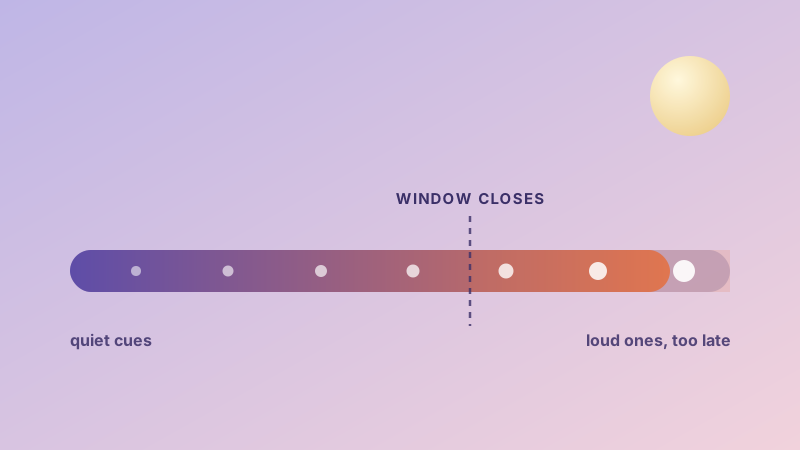
Repeating one flat number from breakfast to bedtime is an easy way for a schedule to stop fitting the day. It is too long in the morning, too short in the evening, and right only around the middle of the day.
A worked day for a four-month-old
A four-month-old, awake for the day at 6:30. The window lengths come from the ladder; the nap lengths are just what happened that day.
- 6:30 awake. 55 minutes, so the room goes dark around 7:10 and she is asleep at 7:25. Forty-five minutes, awake at 8:10.
- 80 minutes. Asleep at 9:30, and this is the long one: 90 minutes, awake at 11:00.
- 105 minutes. Asleep at 12:45 for 75 minutes, awake at 14:00.
- 130 minutes. Asleep at 16:10 for a 40-minute catnap, awake at 16:50.
- 160 minutes, the longest stretch of the day. Asleep for the night at 19:30.
That is eight hours fifty awake, four hours ten of day sleep, and a night to 6:30. That is a little over fifteen hours of night-plus-nap, and the night has feeds inside it, so the sleep itself sits around the top of the 12.5-to-15-hour band — without anyone aiming at it.
If the 12:45 nap had run 30 minutes instead of 75, nothing breaks. The next window opens when she wakes and the afternoon slides earlier, which usually means a short fifth nap and an earlier bedtime. That is the schedule working, not failing.
Two naps, then one
The ramp changes shape as the day loses naps. At eight to fourteen months, two naps means three windows around a midpoint of 200 minutes: about 2h30, 3h20 and 4h10. At fourteen months to two years, one nap means two windows around 315 minutes: about 4h30 in the morning and 6h before bed.
Transitions are the bumpy part, and they take weeks rather than days. Around 8 to 9 months three naps stops fitting and two is not quite enough yet, so the third nap becomes twenty minutes in the car and bedtime comes early. Around 13 to 18 months the same thing happens with the morning nap. Alternating between the old day and the new one for a while is normal.
When the ladder and your baby disagree
The ladder here follows published pediatric sleep research. The 24-hour totals are the published ranges. The figures that follow are what families have written down in Cradle. The figures below are what families have written down in Cradle — the shape of it, not the size of it.
Two are worth sitting with at 3am. About one in seven sleep logs is written between midnight and 5am, which is a statement about logs, not about how many families are awake. And two thirds of sleeps are logged the moment they start, rather than written up later.
All of that describes what parents recorded, not what anything measured. An app is not a monitor, and the sleep nobody had a free hand to write down is invisible, so read the totals as floors. Logged wake windows stretch from about an hour at birth toward two hours by six months. Parents were looking at a schedule when they logged them, so read it as a description of what families logged, not proof of the ladder.
One last thing, and it matters more than the table. A range describes what is typical. It is not a target and it is not a verdict. A baby who wants seventy minutes at an age the table calls ninety to a hundred and twenty is not behind. Babies vary enormously. Use the ladder as a starting guess, then follow the baby in front of you. Anything that genuinely worries you — breathing, weight, feeding, how they seem in themselves — belongs with your baby's doctor, not an app or an article.
Tonight you only need two numbers: the time they woke, and how long the first window is. The rest of the day follows from there.