The three o'clock shift
It is dark, and it has that particular three-in-the-morning quiet. The boiler. A car somewhere. A baby who was asleep four minutes ago and is now very much not. You feed, or you rock, or you stand there holding them doing arithmetic about how many hours are left before the day starts anyway.
The stretch between midnight and five is the least visible shift in infant care. About one in seven of the sleep logs behind this article were written inside it, by parents thumbing a timer in the dark while someone small rearranges the night.
You are not the only one awake. And the waking itself, the thing that feels like the failure, is an ordinary part of how young babies sleep — babies vary enormously, and anything that worries you about your own is a conversation for their doctor rather than an app.
Nothing about a baby who wakes at three is broken, and nothing about the parent who gets up to them is failing.
Sleep is built in cycles, and a baby's are short
Adults sleep in cycles too. We surface at the end of each one, turn over, register the shape of the room and drop back down without ever forming a memory of it. By morning we report having slept straight through. We are wrong, but harmlessly.
A baby does the same thing with two differences. Their cycles are shorter, so there are more of these surfacings in a night. And they do not yet have the trick of rejoining the next cycle on their own. The resettling we do unconsciously is, for them, a skill still arriving.
So a night is not one long block with a fault in it. It is a chain of cycles, and at every join the baby comes near the surface. Most of those moments pass unnoticed. Some of them become a whole parent, standing in the dark. Which ones become which is not a measure of anything we did.
In the early months, the waking is doing a job
Young babies rouse easily, and the easy rousing is not a defect to be trained out in week three. Their stomachs are small, they are growing faster than they ever will again, and feeding is a night activity as much as a day one.
That is why the published total-sleep ranges Cradle uses put a nought-to-twelve-week-old at fourteen to seventeen hours across the whole twenty-four, not banked at night. They describe what is typical; they are not a target, and they are not a verdict on any individual baby. The night is not supposed to be holding all of it yet. It gets there slowly, and unevenly, and not on any date we can circle.
"Sleeping through" is a moving target
The phrase does more quiet damage than almost anything else said to new parents, partly because nobody agrees what it means. Used casually it can mean a five-hour stretch, or a night with no feeds, or a night where nobody remembers getting up. Those are three different nights, and a baby can hit one and miss the others on the same evening.
It is also a poor measure because it squeezes a whole night into a single number, and that number is fragile. In our own records, the longest stretch of a night moves a long way depending on how much a tired parent managed to write down. One unlogged resettle at two in the morning joins two four-hour stretches into a single eight-hour one, and the baby did nothing different. A measure that moves that much on our attention is not telling us much about the baby.
What does change, reliably and visibly, is the shape of the day around the night.
The day has a shape, and it is not flat
A wake window is the time a baby is awake between one sleep and the next. It lengthens with age, and the ranges are wide because babies are:
- Under 6 weeks — 45 to 80 minutes awake, about 6 naps
- 6 to 12 weeks — 60 to 100 minutes, about 5 naps
- 12 to 22 weeks — 90 to 120 minutes, about 4 naps
- 22 to 36 weeks — 115 to 160 minutes, about 3 naps
- 36 to 60 weeks — 175 to 225 minutes, 2 naps
- 60 to 104 weeks — 280 to 350 minutes, 1 nap
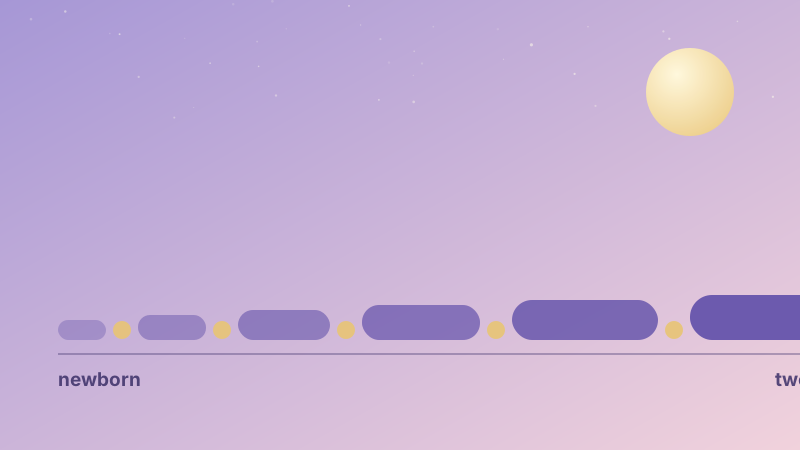
The transitions are gradual. Six naps eases to about five by six weeks, to a steady four around three months, down to two somewhere around eight or nine months, to one between thirteen and eighteen months, and naps usually gone between three and five years. The ladder is built on published pediatric sleep research.
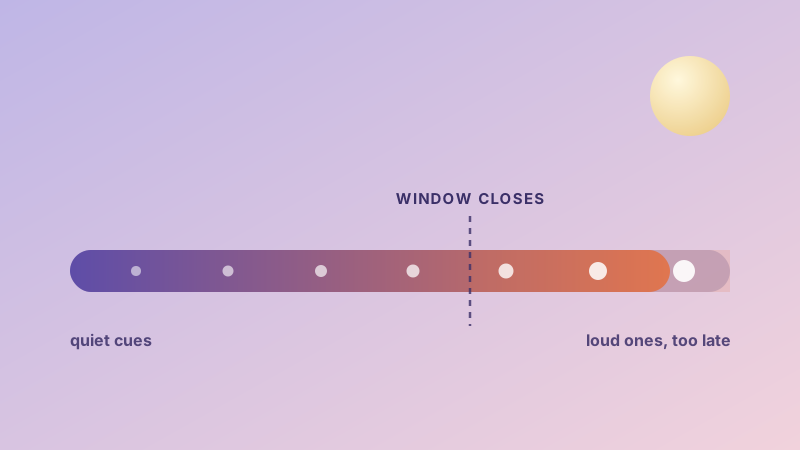
Here is the part that is rarely said out loud, and it is the most useful thing in this article: those windows are not all the same length within a single day. The first window after morning wake-up is the shortest of the day. The one before bedtime is the longest.
Cradle spreads the day's windows around the age midpoint on a ramp that softens as the day loses windows — roughly plus or minus thirty-five per cent when four windows remain, twenty-five at three, fifteen at two.
Take a seven-month-old on three naps. The midpoint for that age is about 138 minutes, so a flat schedule would run 138 minutes awake, four times over. The ramp instead gives roughly 90, 120, 155 and 185. Those four windows add up to the same total awake time. Nothing has been added to the day and nothing taken away. Only the distribution moved.
But the two schedules put the naps in very different places. The flat number puts the first nap of the day about fifty minutes later than the ramped ladder does, and bedtime about fifty minutes earlier. That is a difference between two plans on paper — Cradle has no way to observe when a particular baby was ready, and the ramp is a modelling choice taken from the published protocol, not a measurement of any baby. At nine months on two naps it is cleaner to see: a midpoint of 200 minutes becomes about 150, 200 and 250 across the three windows.
That is why Cradle's ladder does not repeat one number all day: the protocol it follows describes windows that lengthen toward bedtime. What a given schedule does to a given baby's night is not something we can tell you — the app records what parents write down, and it has never measured a baby's sleep.
None of these ranges is a target. They describe the typical pattern in the published protocol the ladder is built on, not a measurement of where babies actually land. They are not a score, and a baby sitting outside one is not behind.
What families actually wrote down
Between the eleventh of May and the fourteenth of August 2026, families logged the sleep logged of baby sleep across merged sleep sessions, and moments in all: 2,154 feeds, 2,146 sleeps, 1,201 diapers, 59 pumping sessions, 33 doses of medicine.
About 1 in 7 sleep logs in Cradle is made between midnight and 5am. Two thirds of sleeps are logged the moment they start, which tells us when the log was written — within a minute of the sleep starting, rather than reconstructed the next morning. It does not tell us anything about how quick or how easy that was at the time.
Read those numbers carefully, because they are records, not measurements. The app is not a monitor. Nothing here observed a baby. Every figure is something a parent wrote down, and the nights when nobody had a free hand are simply invisible. These are floors, not ground truth. The real number of three-in-the-morning wakings is always higher than the real number of three-in-the-morning logs.
If you are awake right now
Nothing here promises the waking stops on a date. It does not work that way, and anybody offering a date is selling something.
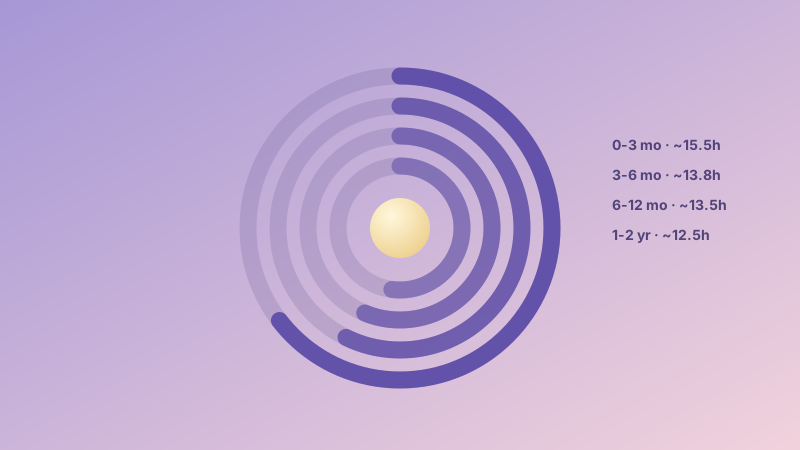
What changes is the shape. The windows lengthen. Six naps become four, then three, then two, then one. Total sleep eases from fourteen to seventeen hours in the first twelve weeks, to twelve and a half to fifteen by six months, twelve to fifteen through the rest of the first year, eleven to fourteen into the second. The night reorganises itself around a baby who is doing more in the day. None of it arrives on a schedule anybody can be held to.
Nothing about a baby who wakes at three is broken, and nothing about the parent who gets up to them is failing.
If something about a baby's breathing, weight, feeding or health is genuinely worrying us, that is a conversation for their doctor, and it is worth having early rather than late. An app cannot answer that one and should not try.
Tonight, though, there is only tonight. Put them down when they seem ready. Log it if we have a free hand and let it go if we do not. One in seven of these logs was written in the dark, at an hour much like this one, and the hour does pass.