The forty-one minutes you wrote down
It is 2:40 in the morning. The baby went down at some point after the feed, you are fairly sure it was 1:58, and the timer says forty-one minutes. Except you started it once you were back in the chair, not when you laid her down, so it was probably closer to fifty. You save it anyway, because the alternative is arithmetic in the dark.
That is worth saying out loud before any chart: a tracker does not watch your baby. It records what you wrote down. The two are related, but they are not the same thing, and the gap between them is where most of the confident claims in this category quietly fall apart.
A tracker does not watch your baby. It records what you wrote down.
Logged is not measured
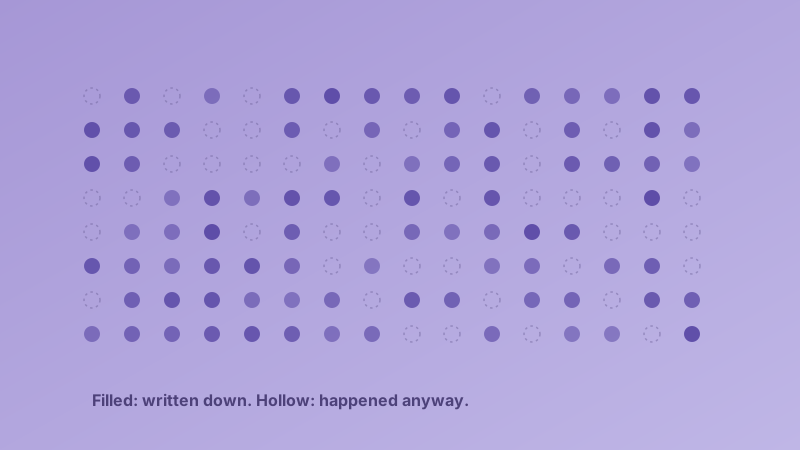
Every figure in an app like this one is a floor, not ground truth.
- A nap nobody logged did not happen, as far as the data is concerned.
- A sleep logged late is shorter in the record than it was in the crib.
- A night you were too tired to open your phone looks, in the data, like a quiet one.
None of that makes the numbers useless. It makes them one-directional. When the record says she slept two hours this afternoon, the honest reading is: at least two hours, as far as we wrote down. Sleep that goes unrecorded is invisible, and it only ever bends the total one way, which is why a logged daily total below the ranges further down this page usually means a missed log rather than a short day.
What our own logs actually say
Families using the app write down sleep as it happens, and the shape of what they record is the useful part — not how much of it there is.
Two of those figures say more than the totals do.
About 1 in 7 sleep logs in Cradle is made between midnight and 5am. Written down at an hour when nobody wants to be doing arithmetic. It is a statement about logs, not about families, and it has to stay that way. We do not publish a sharper number than about: a sleep row carries no timezone, so the local hour is inferred, and the share moves depending on which offset you assume.
Two thirds of sleeps are logged the moment they start. 1,352 of 2,146 were written down within a minute of starting. A live timer produces that shape by construction, so it is not a compliment to anyone's design work. It does mean most of this record is contemporaneous rather than reconstructed at the end of a long day.
The caveat travels with all of it: these are totals across every log in that window, not a portrait of a typical family. Logging is wildly uneven. Some households record everything for months; many record once. No number here describes what a baby on this app does.
The circularity trap
Here is the trap, stated plainly, because most apps will not state it.
The app reads your baby's age, suggests a wake window, and shows you a time. You watch the clock, start winding down near that time, and log the sleep. Then the app counts how close the log came to the suggestion and reports that your days are landing neatly inside the expected range.
Of course they are. You were told the number. A wrong ladder would produce data that looks just as tidy. If every suggestion were twenty minutes too long, the logs would still cluster obediently around it, and the chart would still look like proof.
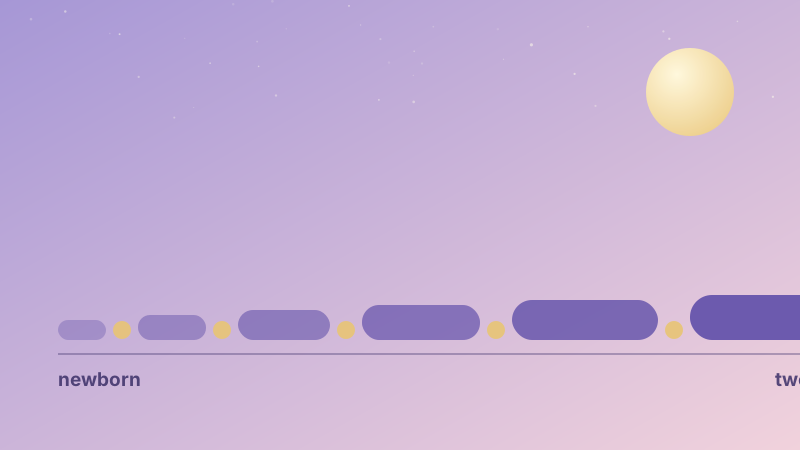
So a chart of logged wake windows by age describes a habit, not a verdict on the method. Cradle's logged wake windows stretch from about an hour at birth toward two hours by six months. That is what families recorded. It is not evidence that the schedule is correct, and we do not present it as any.
What the age tables can tell you
The ladder does not come from our logs, which is the only reason it escapes the circle. Its rungs are taken from published wake-window tables — the protocol in published pediatric sleep research is the primary reference — and adjusted only so the windows and naps at each age add up to a coherent day. They are never fitted to our own data.
Awake time between sleeps, by age:
- Under 6 weeks: 45 to 80 minutes, across about 6 naps
- 6 to 12 weeks: 60 to 100 minutes, about 5 naps
- 12 to 22 weeks: 90 to 120 minutes, about 4 naps
- 22 to 36 weeks: 115 to 160 minutes, about 3 naps
- 36 to 60 weeks: 175 to 225 minutes, about 2 naps
- 60 to 104 weeks: 280 to 350 minutes, one midday nap
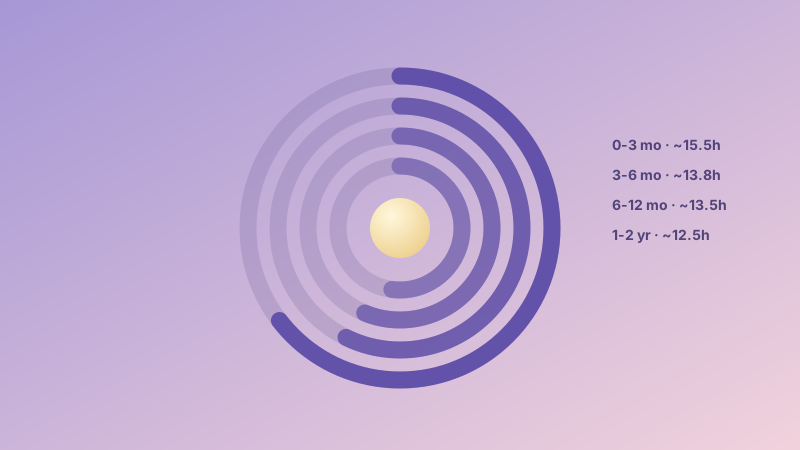
Total sleep in 24 hours, naps and night added together, runs 14 to 17 hours at 0 to 12 weeks, 12.5 to 15 hours at 13 to 26 weeks, 12 to 15 hours through the rest of the first year, and 11 to 14 hours in the second. These totals are a separate reference from the wake-window protocol above — published consensus ranges for total daily sleep, and not from our logs either.
The transitions are the other half of it. Most babies consolidate from around five naps at two months to around four by three months, move to two naps around eight or nine months, to a single midday nap somewhere between thirteen and eighteen months, and out of naps entirely between three and five years.
These bands are wide on purpose. They describe what is typical. They are not a target and not a verdict, healthy babies land all across them, and plenty land outside them.
Why the windows are not all the same length
This is the part that gets missed, and it matters more than any single minute count.
Windows are not all the same length within a day. The protocol the app follows does not use one length all day: the first stretch after morning wake-up is treated as the shortest of the day, the one before bedtime as the longest. A day is a ramp, not a metronome.
The app spreads the day's windows around the midpoint for the age, and the spread softens as the day loses windows: roughly plus or minus 35 percent when there are four windows, 25 percent at three, 15 percent at two. The mean stays on the midpoint, so the total awake time does not change. Only its distribution moves.
For a seven-month-old, whose band is 115 to 160 minutes with a midpoint of 138, across three naps and four windows:
- Morning wake to nap one: about 1h 30m
- Nap one to nap two: about 2h
- Nap two to nap three: about 2h 35m
- Nap three to bedtime: about 3h 05m
Those add up to the same awake total as four identical windows of about two and a quarter hours each. But the flat version keeps a freshly woken baby up about forty-five minutes longer in the morning, and starts the bedtime stretch about forty-five minutes earlier at night. Repeating one number all day is the easiest thing in the world to do, and it produces a different day from the one the ladder describes. Which shape suits a particular baby is not something these logs can settle.
What we will not claim
Some things this data cannot support, so we do not say them.
There has been no controlled trial, so nothing here claims the app makes babies sleep longer, or better, or sooner. There is no percentage improvement to quote, because there is no baseline and no control group to measure one against. A number we could not defend is a number we keep to ourselves. No clinician has reviewed this app, and nothing here is pediatrician-approved.
What the record honestly is: what families wrote down, useful for the questions a record can answer. When did she last eat. How long has he been down. Is today unusual for us, compared with last week. A tracker answers those well, and answering them at 2:40am is worth something on its own.
The questions it cannot answer are the ones that sting at that hour. Whether your baby is normal. Whether we are doing this right. A range is not a report card, a gap in the log is not a failure, and babies vary enormously, including from themselves week to week. Anything genuinely worrying about breathing, weight, feeding or general health belongs with your baby's doctor, not with an app and not with a chart.
The rest is a notebook that adds up. Keep it when it helps, and put the phone down when it does not.