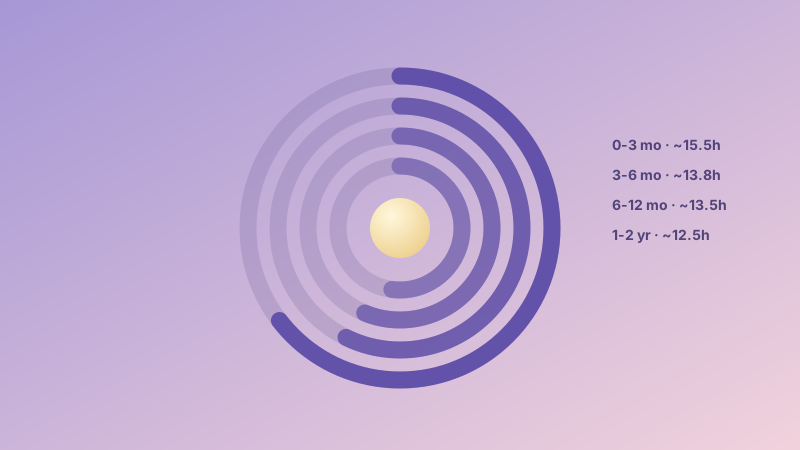
A simple idea with sharp edges
A wake window is the time a baby is awake between one sleep and the next. That is the whole concept, and it takes ten seconds to explain.
Which is exactly why it goes wrong so often. The idea is simple; applying it across a real day, with feeds and a school run and a baby who did not read the chart, is not. These are the seven places it usually breaks.
One number, repeated from breakfast to bedtime, is the single most common way a day quietly stops fitting.
1. Counting from the wrong moment
The window starts when your baby's eyes open, not when you get to the cot. If she surfaced at 6:10 and you lifted her out at 6:30, you are already twenty minutes in.
It ends when she is asleep, not when you start the wind-down. Both errors push in the same direction, and together they can eat half an hour of a ninety-minute window before anyone has done anything wrong.
2. Using one number for the whole day
This is the big one. A single figure, repeated from morning to bedtime, does not describe how a day actually runs.
The first window after morning wake-up is typically the shortest in the day. The stretch before bed is typically the longest — often close to three times it. A baby who slept all night has almost no sleep pressure built up at 7am and a great deal by 6pm.
Give a four-month-old a flat two hours all day and you will fight the first nap and fight bedtime, for opposite reasons, and it will feel like the number is wrong when the number was only ever an average.
The same average, spread across the day rather than repeated. Total awake time is identical either way — only the distribution changes.
3. Waiting for cues before starting
Sleepy cues are real, but they are a lagging indicator. The clear ones — the second wind, the frantic laugh, the arching — tend to arrive after the easy window has already closed.
By then you are not catching a window. You are recovering from one. Use the rough time to decide when to start, and use the cues to adjust from there.
4. Treating the range as a target
A band like “90 minutes to 2 hours” is a description of where settling tends to be easiest across a lot of different babies. It is not a goal, and a baby who consistently runs twenty minutes under it is not behind.
Plenty of healthy babies sit at one end of a range and stay there. The range is a starting point for your baby, not a standard your baby is being measured against.
5. Ignoring what the night did
A day does not start from zero. A baby who was up from two until four is carrying that into the morning, and the first window will usually be shorter than the chart suggests.
The reverse holds too. An unusually long night often means the first stretch can run a little longer than normal. The published bands assume an ordinary night, and plenty of nights are not ordinary.
6. Holding a stage too long
Windows widen as a baby grows, and they widen without announcing it. The schedule that worked in March quietly stops working in April, and the instinct is to try harder at the old schedule rather than move up.
The tells are consistent: the last nap of the day stops going in, bedtime drifts later and later, or early-morning waking appears out of nowhere. One bad week is a bad week. The same pattern four days out of seven, for a fortnight, usually means the day has one nap too many or a window too short.
7. Moving up too fast
The opposite error, and just as common once someone has read about transitions. A few hard days is not a nap drop. Teething, a leap, a cold or a week of travel all produce the same symptoms and all resolve on their own.
Drop a nap a month early and you get an overtired baby, a worse bedtime and an early waking — which looks exactly like the problem you were trying to fix, so the temptation is to drop another one.
What to do instead
- Start the clock at eyes-open and end it at asleep. Put the settling time inside the window.
- Fan the windows across the day. Shortest first, longest before bed.
- Begin the wind-down on the time, then let the cues adjust it.
- Give a change two weeks before deciding it did not work.
- Let your baby's own pattern win over any chart, including this one.
Every range here describes what is typical across a great many very different babies. It is not a target and not a verdict on yours, and anything that genuinely worries you about your baby's health is a conversation for your doctor rather than an app.