“Day-night confusion” is the wrong description
The standard phrase for a newborn who sleeps all afternoon and is wide awake at 2am is day-night confusion, as though a baby has the right idea the wrong way round.
We went and looked at when sleep actually starts across the clock in the sleep families log in Cradle. For the first six weeks there is no round the wrong way, because there is barely a round at all.
Nothing is confused. A newborn is not muddling up a day and a night they already have — the day has not been built yet.
What the clock looks like at six weeks
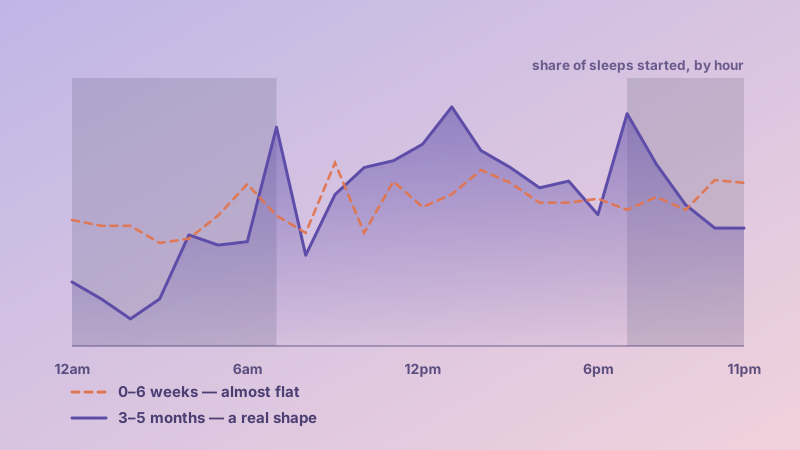
Take every logged sleep in the first six weeks and sort it by the hour it began. If a newborn had no day-night preference whatsoever, every hour would hold about 4.2% of them — one twenty-fourth of the total.
The real spread runs from about 3% in the quietest hour to about 5% in the busiest. That is close to flat. Sleep begins at 3am about as readily as it begins at 3pm.
How many times more sleeps begin in the busiest hour of the day than in the quietest. 1× would mean no pattern at all. From sleep logged in Cradle, smoothed over a three-hour window so a single spiky hour cannot set the number. These are logged start times, not measured sleep, and local time is approximate.
Then a day appears
By three to five months the same chart is a different shape entirely. The quietest hour is 2am, holding well under 1% of sleep starts. The busiest is the early afternoon, at around 7%.
Three peaks show up, and they are recognisable:
- Around 7am — the morning wake-up, and the short first window that follows it.
- Around 1pm — the midday nap, the most reliable sleep of the day at this age.
- Around 7pm — bedtime.
None of those existed six weeks earlier. The schedule most parents are trying to run from week two is visible in the data from about week twelve.
Why it happens when it happens
Newborns are not born with a working body clock. The internal rhythm that eventually anchors sleep to darkness takes a couple of months to come online, and until it does, sleep is driven almost entirely by how long a baby has been awake and when they last fed — neither of which cares what time it is.
So the flat clock is not a failure of routine. It is what sleep looks like before there is a clock to hang it on.
The hour that goes quiet first
If you want one number for the whole change, use 2am.
In the first six weeks, roughly one sleep in thirty begins at 2am — almost exactly the share you would expect if sleep ignored the clock entirely. By three to five months that hour holds under one in a hundred.
Nothing was trained out. What happened is that the long night stretch stopped ending at 2am, so there was no new sleep to begin there. The quiet hour is not a baby sleeping more; it is a baby interrupting less.
Bedtime shows up before the rest of it
Of the three peaks that appear by three months, the evening one is the most useful to watch for, because it tends to firm up first and it is the one you can see without a chart.
A newborn does not have a bedtime — they have a last sleep, which could start at 7pm or 10pm or anywhere between. When the same rough hour starts repeating on its own, without you pushing it, that is the clock coming online. From there the morning wake-up usually steadies next, and the midday nap settles last.
Why the first weeks feel so much harder than they look on paper
A newborn and a four-month-old can log a similar amount of total sleep in a day. The difference is not how much — it is how it is cut up, and when.
At six weeks that sleep arrives in pieces scattered across all twenty-four hours, which means no stretch of the night is reliably yours. By three months the same total has pulled itself into a long night block and a few daytime naps, and the clock has a shape you can plan around.
So the exhaustion of the first two months is not a sign you are managing it badly. You are awake more because the sleep is distributed in the one pattern that costs a parent the most, and no routine fixes that before the rhythm exists.
What that means for the first two months
- A six-nap newborn timetable is close to fiction. You can write one down, but there is no underlying rhythm for it to match.
- Wake windows still work. They are measured from the last sleep, not from the clock, which is exactly why they are useful in a period that has no clock.
- Light and dark are worth doing anyway — bright days, dim nights — but as input to a rhythm that is still forming, not as a switch that flips.
- The 2am stretch is not a problem to solve yet. At six weeks it is simply one more hour, no different to the baby than 2pm.
What this is, and what it is not
Every figure here describes when sleep was written down in Cradle, not what a monitor observed. A sleep nobody logged is invisible to us, so these are floors rather than ground truth, and local time is approximate.
It is also a description, not a timetable. Some babies find a rhythm earlier than this and some considerably later, and a baby still flat at twelve weeks is not a baby with a problem. Anything that genuinely worries you — feeding, weight, breathing, or a baby who seems unwell rather than unsettled — is a conversation for your doctor rather than an app.