The thing nobody puts on the chart
Most nap guidance tells you how many naps belong in a day at a given age. Almost none of it tells you how often that number is about to change — which, day to day, is the part that actually costs you.
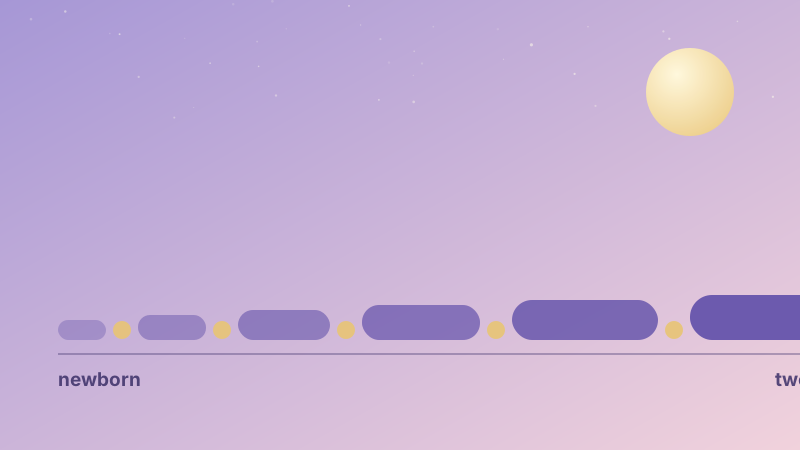
Laid out end to end, the age bands Cradle schedules from contain six nap transitions between newborn and preschool. They are not evenly spaced. They are heavily front-loaded, and knowing that changes what the first half-year feels like.
The early months are not harder because you are doing them wrong. They are harder because the schedule genuinely changes three times before your baby is half a year old.
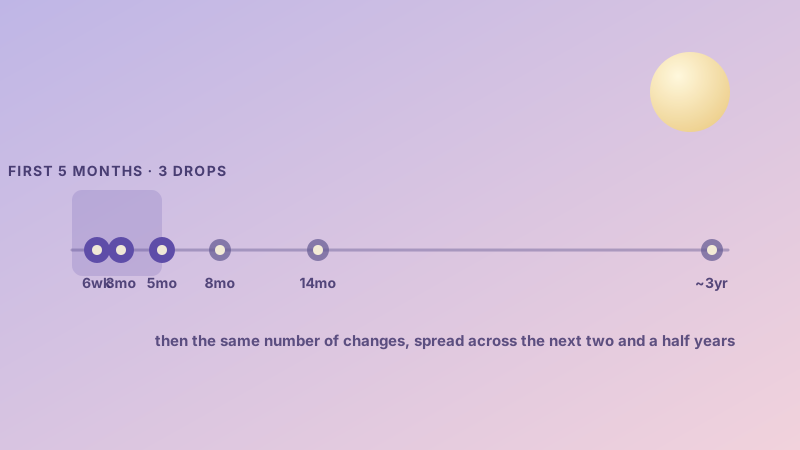
Three before five months. Three across the next two and a half years.
The drops land at roughly six weeks, three months, five months, eight months, fourteen months, and somewhere around three years.
Which means that by the time a baby is five months old, half of every nap transition they will ever make is already behind them. The remaining half is spread thin across the following two and a half years.
Derived from the nap counts by age that Cradle schedules from. The gap between transitions roughly doubles each time, so the same amount of change is packed into the months when you have least capacity for it.
Why that makes the early months feel the way they do
Every transition costs about the same in effort: a stretch of bad days, a bedtime that drifts, a week of wondering whether something is wrong.
In the first five months you pay that cost three times, on the least sleep you will ever have. After fourteen months you pay it once, and then not again for the better part of two years — by which point you are sleeping and the change is barely noticeable.
The workload is not spread evenly. Neither is your capacity for it, and the two are working against each other exactly when it is hardest.
What each of the six actually looks like
They are not interchangeable. Each drop has its own character, and knowing which one you are in tells you what to expect.
- 6 to 5 naps, around six weeks. Barely noticeable. Newborn sleep is so fragmented that losing one nap mostly just lengthens the others.
- 5 to 4, around three months. Often tangled up with the change in sleep architecture that happens around the same time, which is why this period gets blamed on a “regression” when two separate things are happening at once.
- 4 to 3, around five months. The first one most parents actually notice. The day starts to have a recognisable shape.
- 3 to 2, around eight months. Usually the smoothest, because by now the naps are long enough to carry the day between them.
- 2 to 1, around fourteen months. The hardest of the lot, and the one most often attempted too early. One nap has to cover a stretch that two used to.
- 1 to none, somewhere around three. Gradual, and frequently disputed by everyone except the child.
Why the gaps keep doubling
The spacing is not arbitrary. Each drop happens when a baby can comfortably stay awake long enough that the existing number of naps no longer fits into a day.
Early on, wake windows lengthen fast in relative terms — going from about an hour to about two is a doubling, and it happens inside a few months. Later, the same proportional change takes far longer, because the baseline is already long. So the schedule stops fitting less and less often, and the gap between transitions stretches out.
The one that catches people out
Two naps to one is where most of the trouble lands, and the front-loading is part of why. By fourteen months it has been six months since the last transition. The rhythm of constant change has stopped, and this one arrives out of a long quiet stretch.
It is also the largest single jump in awake time of any of them, and the most commonly attempted early — usually because one nap started refusing to go in, which is just as likely to mean the first nap is now too long or too early as it is to mean the day needs restructuring.
A few bad days is not a transition. The same pattern four days out of seven, across a fortnight, usually is.
What follows from it
- A schedule that stops fitting is the normal case early on, not a warning sign. Before five months, something is genuinely changing every six to fourteen weeks.
- Do not diagnose from one bad week. With transitions this close together, a rough patch is as likely to be the next one arriving as it is to be a problem.
- Expect the reverse later. After the two-to-one drop, the schedule is fairly stable for a long stretch. If something goes wrong at eighteen months, it is usually not a nap transition.
- The effort curve improves on its own. Not because it gets easier to manage, but because there is simply less of it to manage.
What this is and is not
These are the age bands the app schedules from, and the timing is a description of what is typical across a great many different babies. Plenty of babies drop a nap weeks either side of these, and some skip a stage almost entirely.
It is not a schedule to hold your baby to, and a baby who transitions early or late is not a baby with a problem. Anything that genuinely worries you about your baby's health is a conversation for your doctor rather than an app.